
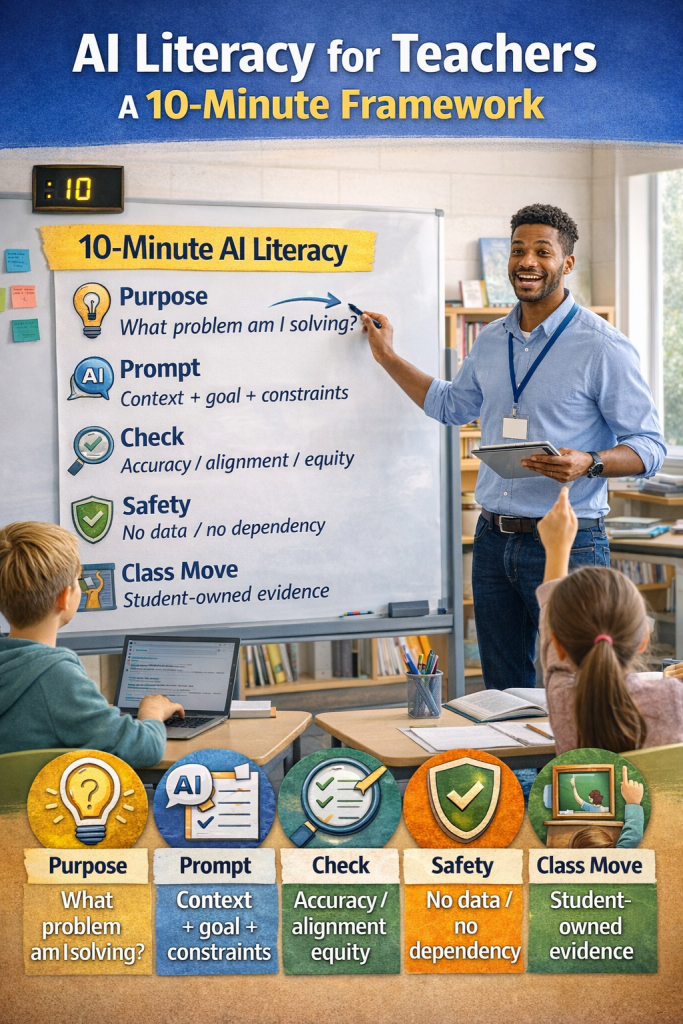
Some days, “AI in education” feels like a moving train: new tools, new policies, new worries, and not enough time to keep up. The mistake is thinking AI literacy requires a course, a badge, or a perfect toolbox.
It doesn’t.
AI literacy for teachers can start as a 10-minute routine—short enough to fit between classes, consistent enough to build confidence, and practical enough to improve your lesson design and assessment right away.
What follows is a simple framework you can repeat weekly (or even daily) to stay in control of AI—without becoming a tech specialist.
The 10-minute AI Literacy Routine
Think of this as a “micro-lab” for professional judgment. It has five steps:
- Purpose (1 minute): “What teaching problem am I solving?” Before opening any tool, write one sentence:
“I want students to practice argumentative writing with stronger evidence.”
“I want to differentiate reading tasks without lowering expectations.”
“I want faster formative feedback without doing the thinking for them.”
If you can’t name the problem, AI will happily give you output… and waste your time.
- Prompt (2 minutes): “Give the model the context it needs, not the job you should do.” Use a short template that keeps you in charge:
Prompt template (copy/paste):
You are helping me as a teacher. Context: [grade/age], subject: [subject], topic: [topic].
Learning goal: [one goal].
Constraints: [time, resources, language level, inclusion needs].
Output format: [bullet plan / rubric / examples / feedback stems].
Safety: Avoid personal data and do not invent facts; ask clarifying questions if needed.
Now produce: [specific request].
Example:
Context: Grade 8, English. Learning goal: students write a paragraph with claim + evidence + reasoning.
Constraints: 20 minutes, mixed proficiency, 2 students with reading support.
Output: 3 scaffolded prompts + a simple success criteria checklist.
Now produce: …
Two-minute rule: If your prompt is getting long, you’re probably asking for something too big. Make it smaller.
- Check (3 minutes): “Trust your expertise, verify the output.” This is the core of AI literacy: evaluation.
Use a quick 3-check scan:
Accuracy: Are facts, definitions, and examples correct? Anything suspicious or too confident?
Alignment: Does it truly match the learning goal and the level of your students?
Equity: Does it assume prior knowledge, cultural context, or language proficiency that some students won’t have?
If it fails any check, don’t “polish” it. Regenerate with constraints or rewrite key parts yourself.
- Ethics & Safety (2 minutes): “Could this harm students or break policy?” Ask yourself:
Am I using or entering personal student data? (If yes: don’t.)
Does this encourage dependency (students outsourcing thinking) instead of learning?
Does it create bias risks (stereotypes, unfair assumptions, inaccessible language)?
Am I clear about acceptable student use of AI for this task?
AI literacy isn’t only “how to use tools.” It’s knowing when not to use them.
- Classroom Move (2 minutes): “What will students do—without AI doing the learning?” End with a simple implementation decision:
What will students produce (evidence of learning)?
What will be done without AI (core thinking)?
If students use AI, what is the allowed role (brainstorming, checking clarity, generating practice questions, etc.)?
A strong default:
AI can help prepare (teacher side) and practice (student side).
Assessment should require student-owned evidence (process notes, drafts, in-class writing, oral explanation, reasoning trace).
5 Practical Keys That Make This Work
Key 1: Keep AI “inside the lesson design,” not “instead of it”
Use AI to generate options, then apply your professional judgment. You are the curriculum.
Key 2: Write one “non-negotiable learning evidence”
Before using AI, decide the evidence you’ll accept:
-
a written paragraph,
-
a solved problem set with reasoning,
-
a recorded explanation,
-
an exit ticket with justification.
AI literacy grows when you anchor decisions to evidence.
Key 3: Build a small prompt library (not a tool library)
Teachers don’t need 30 apps. They need 5–10 prompts they can trust:
-
differentiation,
-
exemplars,
-
rubrics,
-
feedback stems,
-
misconceptions and quick checks.
Key 4: Teach students the “AI honesty rule”
If students use AI, require a simple disclosure:
-
Where did AI help? What did you change? What is fully yours?
This reduces policing and increases responsibility.
Key 5: Use AI to improve your feedback systems
Great teacher use cases:
-
drafting feedback sentence stems,
-
creating self-assessment checklists,
-
generating alternative explanations,
-
designing low-stakes practice quizzes.
Avoid: generating final grades or replacing your evaluation of student work.
A 10-minute example (realistic and repeatable)
Goal: students improve reasoning in science explanations.
In 10 minutes you:
Write purpose: “Improve CER explanations—reasoning is weak.”
Prompt: ask for 3 reasoning sentence starters + 2 common misconceptions.
Check: ensure misconceptions are correct and age-appropriate.
Ethics: no student data, no “answer key disguised as learning.”
Classroom move: students write CER, then use the starters to revise, then do a 2-question exit ticket explaining a choice.
That’s AI literacy in action: purposeful, critical, safe, and classroom-ready.
Your 10-minute AI Literacy Checklist (save this)
Purpose: What problem am I solving?
Prompt: Context + goal + constraints + output format
Check: Accuracy / Alignment / Equity
Safety: No personal data, no dependency, clear student rules
Classroom move: Student-owned evidence + thinking stays human
AI in education will keep changing. Your advantage isn’t keeping up with every new tool—it’s building a repeatable habit of professional judgment.
Which step of the 10-minute routine would make the biggest difference in your week: Purpose, Prompt, Check, Safety, or Classroom Move?
