
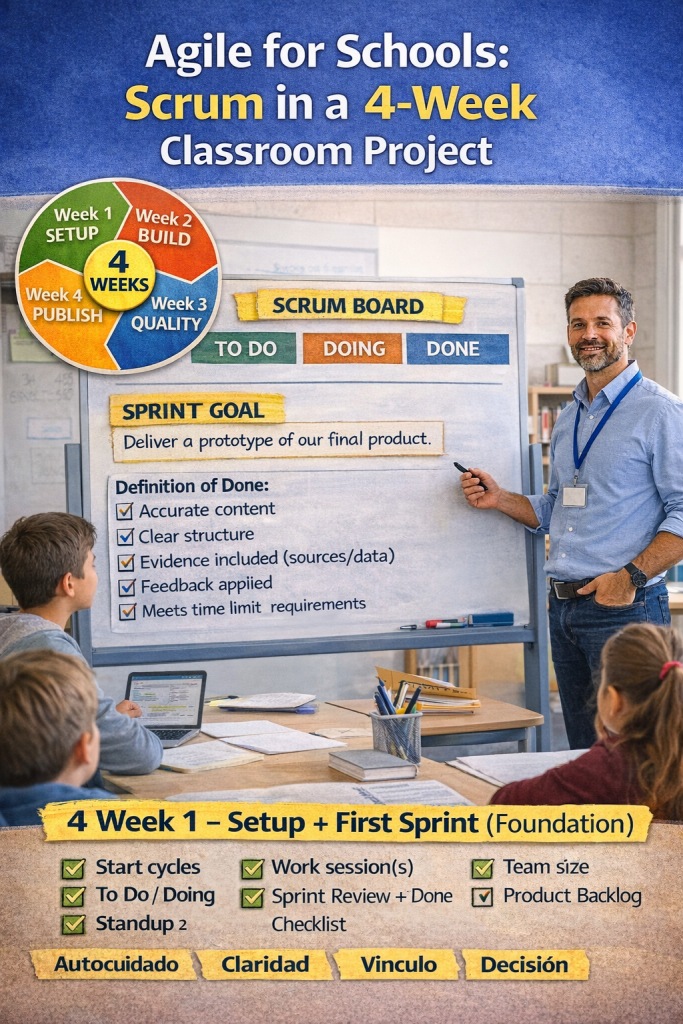
“Scrum” can sound like something reserved for software teams, sticky notes, and jargon. In a classroom, we need the opposite: a structure that reduces chaos, clarifies expectations, and helps students learn to plan, collaborate, and reflect.
Used well, Scrum becomes a simple learning routine—especially for projects that usually drift: group work, inquiry tasks, presentations, portfolios, interdisciplinary challenges.
This post gives you a 4-week, classroom-ready Scrum project you can run in almost any subject, with clear roles, rituals, and templates.
What Scrum looks like in a classroom (no jargon, just learning)
Scrum is a lightweight way to run a project through:
Short cycles (weeks)
Visible work (a board)
Clear priorities (a backlog)
Regular check-ins (standups)
Frequent feedback (reviews)
Reflection and improvement (retrospectives)
The goal isn’t to “do Scrum perfectly.”
The goal is to help students learn how to work.
The 4-week project: Overview
The project idea (adaptable)
Choose a deliverable that fits your subject:
A public awareness campaign (posters + short video)
A science investigation report + presentation
A historical podcast episode
A “how-to” guide for younger students
A digital magazine / exhibition
A community problem proposal (school improvement pitch)
Team size
3–5 students per team works best.
Time
2–3 sessions per week (adjustable). Scrum is the structure; you set the content.
Roles (simple and student-friendly)
Product Owner (PO) — “The value keeper”
Keeps the team focused on the goal and quality
Checks criteria and makes sure the work serves the audience
In school: this can rotate weekly to avoid hierarchy
Scrum Master (SM) — “The process helper”
Keeps meetings short and respectful
Notices blockers and helps the team solve them
Not the boss—more like a facilitator
Team Members — “The makers”
Build the deliverable
Share responsibility
Own deadlines and evidence
Teacher role: you are the coach + final quality gate, not the manager. You set constraints, mini-lessons, and success criteria.
The 4 Scrum rituals (school version)
- Sprint Planning (30–45 minutes, once per week) Students decide:
What they will deliver by the end of the week
Who does what
What “done” means
- Daily/Regular Standup (5 minutes, 1–2 times per week) Each student answers:
What did I complete?
What will I do next?
What is blocking me?
- Sprint Review (15–25 minutes, end of week) Teams show their work in progress. Peers give feedback using a simple protocol.
- Retrospective (10–15 minutes, end of week) Teams reflect:
What worked?
What didn’t?
What will we improve next week?
The 4-week plan (step by step)
Week 1 — Setup + First Sprint (Foundation)
Goal: define the project, build the backlog, start producing.
Session 1: Launch (teacher-led + team setup)
Explain the driving question and final deliverable
Share the rubric or success criteria (keep it short)
Form teams and assign roles (temporary)
Session 2: Backlog building
Teams create a Product Backlog (a list of tasks), for example:
Research sources
Interview questions
Draft outline
Design visuals
Script writing
Proofreading
Build prototype
Test with peers
Final edit
Session 3: Sprint Planning
Each team chooses tasks for Sprint 1 and defines:
Sprint goal (one sentence)
Tasks and owners
Definition of Done (DoD), e.g.:
“Includes 2 reliable sources”
“Has a clear audience”
“Meets time limit”
“Citations included”
“Peer feedback applied”
Teacher move (high impact): give a short mini-lesson on “good evidence” or “quality criteria” early.
Deliverable by end of Week 1: prototype or draft (rough but real).
Week 2 — Sprint 2 (Build + Improve)
Goal: strengthen content and structure.
Standup 1 (5’)
Work session(s)
Standup 2 (5’)
Sprint Review + feedback (20’)
Retrospective (10’)
Feedback protocol (fast and kind):
1 glow (what works)
1 grow (one improvement)
1 question (clarity)
Teacher move: hold a “clinic” table for common issues (structure, reasoning, clarity, misconceptions).
Deliverable by end of Week 2: a strong draft (content complete).
Week 3 — Sprint 3 (Quality + Evidence)
Goal: polish, verify, and make learning visible.
This is where you prevent “pretty but shallow” projects.
Add a quality checkpoint:
Evidence page / appendix
Learning log or reflection notes
Citations / bibliography
Process proof (draft history, checklist, peer feedback notes)
Teacher move: introduce “quality gates”:
Gate 1: minimum content requirements met
Gate 2: accuracy and evidence checked
Gate 3: communication quality (audience + clarity)
Deliverable by end of Week 3: near-final product + evidence pack.
Week 4 — Sprint 4 (Publish + Reflect)
Goal: deliver, share, and consolidate learning.
Sprint Review becomes the showcase:
Presentations, gallery walk, podcasts, demo day, exhibition
Invite another class, teachers, or families (optional)
Final Retrospective (15’):
What did we learn about the topic?
What did we learn about teamwork?
What would we do differently next time?
Deliverable by end of Week 4: final product + team reflection.
Tools you need (minimal)
A Scrum board: whiteboard, poster paper, or digital board
Columns: To Do / Doing / Done (optional: Blocked)
A backlog list (paper or digital)
A Definition of Done checklist
A simple rubric (4–6 criteria max)
Assessment: keep it fair and learning-focused
Group projects fail when assessment feels unfair. Scrum helps—if you assess evidence.
A balanced approach:
Product (40–50%): quality of final outcome
Process (30–40%): board updates, logs, applying feedback, meeting DoD
Individual contribution (10–20%): self + peer check, brief individual reflection
Simple individual evidence ideas:
5-line weekly reflection
“What I did / what I learned / what I’ll do next”
Short oral explanation of one part of the project
Common pitfalls (and how to avoid them)
Pitfall 1: Scrum becomes “meetings instead of making”
Fix: Standups are 5 minutes. Reviews are short. Most time is work time.
Pitfall 2: The loudest student becomes the manager
Fix: Rotate roles weekly. Use structured turn-taking in standups.
Pitfall 3: Students rush the product and skip learning
Fix: Require an evidence pack and “quality gates.”
Pitfall 4: The board is decorative
Fix: Make the board part of assessment (process evidence) and update it twice a week.
A ready-to-copy template (for your classroom)
Sprint Goal (Week X):
By Friday, we will deliver __________ for __________ (audience) and meet these criteria: __________.
Definition of Done (tick when true):
Accurate content
Clear structure
Evidence included (sources/data)
Feedback applied
Meets format/time requirements
Standup prompts:
Done:
Next:
Blocked:
Scrum won’t fix everything. But in four weeks, it can reliably build what many projects lack: clarity, accountability, feedback habits, and reflection—the real foundations of deeper learning.
If you ran this next month, what would your project deliverable be (poster, podcast, video, exhibition, report), and which week do you think your students would struggle the most: Week 1 (setup), Week 2 (build), Week 3 (quality), or Week 4 (publish)?
