
Retrospectives aren’t just for Agile teams—they’re one of the simplest ways to help students build metacognition, ownership, and classroom culture. When they work, students feel heard, teams improve, and projects get smoother. When they flop, they feel like a complaint session or “one more thing” at the end of class.
The difference is structure.
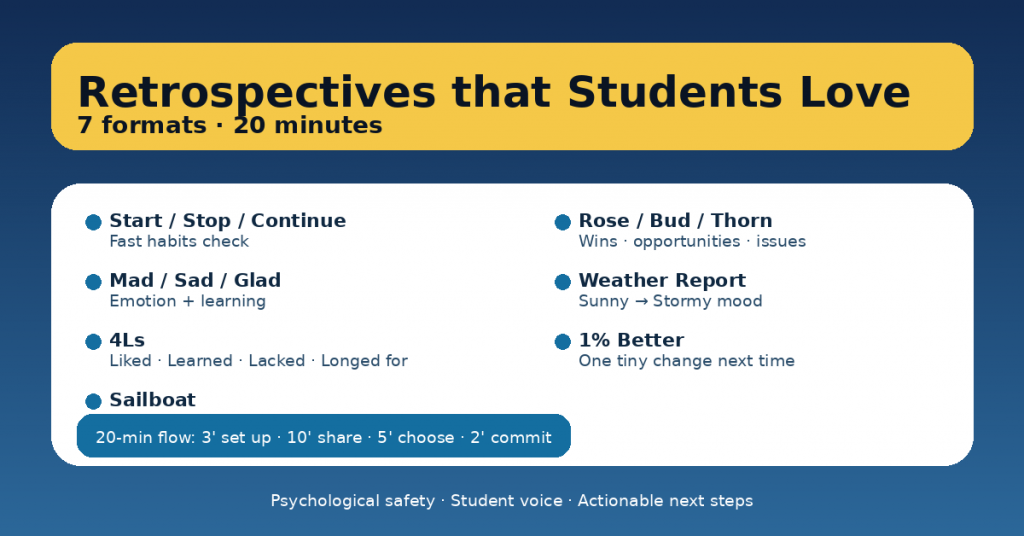
This post gives you 7 student-friendly retrospective formats you can run in 20 minutes, even with a busy timetable—and a quick facilitation flow that keeps it safe, focused, and action-oriented.
The 20-minute retro flow (works with any format)
0) Set the tone (1 minute)
-
“We’re improving the process, not judging people.”
-
“One voice at a time, respect first.”
1) Individual thinking (2 minutes)
Students write silently first (sticky notes or a simple template). Silent time prevents domination.
2) Share & cluster (8 minutes)
In groups or whole class:
-
share notes,
-
cluster similar ideas,
-
label themes (e.g., “time,” “roles,” “instructions,” “communication”).
3) Choose one improvement (5 minutes)
Vote (dot voting or hand vote). Choose one change to try next time.
4) Commit (4 minutes)
Write it as an experiment:
-
We will…
-
So that…
-
We’ll know it worked when…
Assign a small owner and date.
The secret: one change beats ten opinions.
7 formats students actually enjoy (and why they work)
1) Start / Stop / Continue
Best for: any project, quick improvement
Prompt:
-
Start: What should we begin doing?
-
Stop: What should we stop doing?
-
Continue: What’s working well?
Why students like it: it feels practical and fair—there’s always something to continue.
Teacher tip: require at least one “continue” note per student to avoid negativity spirals.
2) Mad / Sad / Glad
Best for: teamwork tension, motivation dips, classroom climate
Prompt:
-
Mad: What frustrated us?
-
Sad: What disappointed us?
-
Glad: What made us proud?
Why students like it: it validates feelings without turning into drama—if you keep it respectful.
Teacher tip: if emotions are high, switch to “Concerned / Disappointed / Proud” for calmer language.
3) The 4Ls: Liked / Learned / Lacked / Longed for
Best for: deep learning reflection + improvement
Prompt:
-
Liked: What worked well?
-
Learned: What did we learn (content or teamwork)?
-
Lacked: What was missing?
-
Longed for: What do we wish we had next time?
Why students like it: it balances celebration, learning, and improvement in a structured way.
Teacher tip: ask for at least one “Learned” connected to the curriculum goal.
4) Sailboat (Winds / Anchors / Rocks)
Best for: projects that feel stuck or complex
Prompt:
-
Winds: What helped us move forward?
-
Anchors: What slowed us down?
-
Rocks: What risks do we see ahead?
Why students like it: it feels like storytelling and makes obstacles “external,” not personal.
Teacher tip: after identifying anchors, ask: “Which anchor can we lift this week?”
5) Rose / Bud / Thorn
Best for: quick check-ins, first-time retros
Prompt:
-
Rose: A success
-
Bud: An opportunity or idea
-
Thorn: A challenge
Why students like it: short, visual, and easy to understand.
Teacher tip: turn each “thorn” into a “bud” by asking: “What’s one small step to improve it?”
6) Weather Report (Sunny → Stormy)
Best for: class mood, energy management, wellbeing
Prompt:
-
What’s our weather today (sunny/cloudy/rainy/stormy)?
-
What created that weather?
-
What would improve the forecast next time?
Why students like it: it’s playful, low-pressure, and works with younger or reluctant groups.
Teacher tip: focus on classroom choices, not personal details: “What can we do as a group?”
7) 1% Better
Best for: avoiding overwhelm and building consistency
Prompt:
-
What is one tiny change that would make us 1% better next time?
Why students like it: it feels achievable and reduces perfection pressure.
Teacher tip: write the chosen 1% improvement on the board at the start of the next session.
Make retrospectives safe (so students stay honest)
A retro fails when students fear blame or ridicule. Build psychological safety with three norms:
-
Talk about actions, not people
-
“We interrupted a lot” instead of “He talks too much.”
-
Be specific
-
“We didn’t share files until the last day” beats “Our communication was bad.”
-
Assume good intent
-
The goal is improvement, not punishment.
If needed, allow anonymous notes for the first two retros.
Turn the retro into learning evidence
To make this more than “feelings,” capture:
-
one photo of the board,
-
the chosen improvement experiment,
-
a 2-sentence student reflection:
“What I contributed / what I’ll do next time.”
That’s powerful formative evidence for collaboration skills.
