
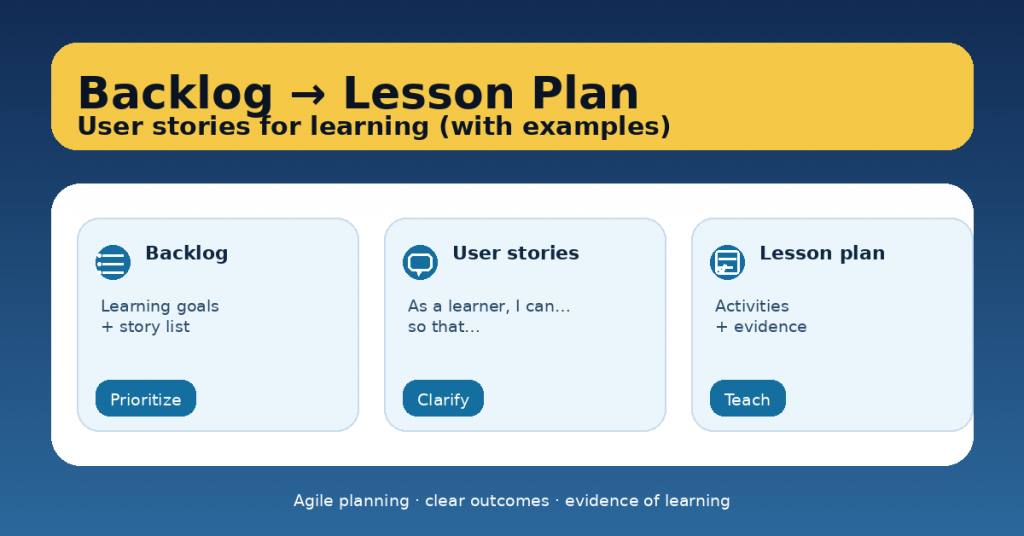
“Agile” gets real in classrooms when planning becomes clearer, lighter, and more responsive. One of the easiest bridges from Agile to teaching is the backlog: a visible list of what students need to learn next, broken into small, teachable chunks.
But a backlog only helps if it translates into lessons that produce evidence of learning—not just activity. That’s where user stories for learning come in.
This article shows how to go from Backlog → User Stories → Lesson Plan, with templates and examples you can copy.
1) What a learning backlog is (and what it’s not)
A learning backlog is a prioritized list of:
-
learning goals (knowledge + skills),
-
small learning items (micro-outcomes),
-
practice opportunities,
-
evidence students will produce.
It is not:
-
a list of tasks (“make a poster”),
-
a calendar (“Week 3: chapter 5”),
-
a teacher to-do list.
Backlog mindset: “What’s the next most valuable learning move?”
2) The learning user story template
In software, user stories capture value from the user’s perspective. In learning, they capture value from the learner’s perspective.
Template (simple)
As a learner, I can [do something observable] so that [I can achieve a purpose].
Add acceptance criteria (the secret sauce)
Acceptance criteria answer: How will we know it’s done?
Done means:
-
I can do it independently (or with defined support),
-
under specified conditions,
-
producing specific evidence.
3) From story to lesson plan: the 5-step method
Step 1: Write 3–6 user stories for the unit
Don’t overdo it. A small set keeps the unit teachable.
Step 2: Prioritize (value first)
Pick the stories that unlock others (foundational concepts, core skills).
Step 3: Define “Done” before teaching
Write a short checklist: what must be true for success?
Step 4: Design learning increments
Turn each story into:
-
a mini-model (teacher input),
-
guided practice,
-
independent practice,
-
a quick check.
Step 5: Capture evidence (not vibes)
Plan what you will collect:
-
exit ticket,
-
short explanation,
-
worked example,
-
paragraph draft,
-
oral response.
4) Examples you can copy (backlog + stories + evidence)
Example A: English / Language Arts (argument writing)
Backlog items (prioritized):
-
Claim + reason
-
Evidence selection
-
Reasoning (link evidence to claim)
-
Cohesion (connectors)
-
Counterargument (basic)
User stories:
-
As a learner, I can write a clear claim and a reason so that my reader knows my position.
-
As a learner, I can select two relevant pieces of evidence so that my argument is supported.
-
As a learner, I can explain how my evidence supports my claim so that my reasoning is convincing.
Acceptance criteria (Done):
-
Claim is specific (not a topic)
-
Two pieces of evidence are relevant and cited (basic)
-
Reasoning uses “because/therefore/this shows…”
Lesson evidence:
-
Exit ticket: claim + reason
-
Annotated evidence choice (highlight + one sentence why)
-
CER paragraph draft with one revision
Example B: Science (ecosystems)
Backlog:
-
Identify biotic/abiotic factors
-
Model energy flow (food chain/web)
-
Predict impact of a change
-
Explain using scientific vocabulary
User stories:
-
As a learner, I can classify factors as biotic or abiotic so that I can describe an ecosystem accurately.
-
As a learner, I can predict how removing one species affects others so that I can explain system change.
Done means:
-
Correct classification in 8/10 examples
-
Prediction includes at least 2 downstream effects
-
Explanation uses target vocabulary (producer/consumer, etc.)
Evidence:
-
Sorting task + quick quiz
-
“If…then…” causal explanation (short written response)
-
Diagram + spoken explanation (1 minute)
Example C: Math (linear functions)
Backlog:
-
Interpret slope and intercept
-
Graph from an equation
-
Write equation from a graph/table
-
Solve a real-world problem
User stories:
-
As a learner, I can explain what slope means in context so that I can interpret real situations.
-
As a learner, I can write a linear equation from a table so that I can model patterns.
Done means:
-
Uses correct units/meaning for slope
-
Writes equation accurately from 4-point table
-
Checks by substituting
Evidence:
-
Two worked examples with annotations
-
Mini-task: “Explain slope in one sentence”
-
Short real-world modelling problem
Example D: Languages (speaking routine)
Backlog:
-
Core conversation chunks (greetings, requests)
-
Asking follow-up questions
-
Using past tense to recount
-
Fluency strategies (fillers, pauses)
User stories:
-
As a learner, I can ask two follow-up questions so that I can keep a conversation going.
-
As a learner, I can recount a short event using past tense so that I can tell a clear story.
Done means:
-
Uses two follow-up question stems correctly
-
Past tense accuracy at an agreed threshold
-
45–60 seconds speech with clear structure
Evidence:
-
Recorded role-play + self-checklist
-
Teacher quick rubric (3 criteria)
-
“Next step” target for next lesson
5) Make it classroom-friendly: the “3 artifacts” rule
To keep Agile planning from becoming paperwork, stick to three artifacts:
-
Backlog board (visible list of learning stories)
-
Definition of Done (short checklist)
-
Evidence plan (what students will produce + when)
That’s enough to create clarity and momentum.
6) Common mistakes (and fixes)
Mistake: stories describe activities (“make a poster”).
Fix: stories describe learning (“explain, justify, model, compare…”).
Mistake: “Done” is vague (“understands concept”).
Fix: “Done” is observable (“can solve 4/5 problems and explain steps”).
Mistake: too many stories at once.
Fix: limit to 3–6 per unit and run short cycles.
Mistake: evidence only at the end.
Fix: build a quick check into every story.
