
Most teacher teams don’t fail because people don’t care. They fail because improvement competes with everything else: urgent emails, last-minute incidents, marking overload, and meetings that end without decisions.
Agile leadership isn’t about turning schools into tech companies. It’s about creating a steady cadence of small improvements—with rituals that protect time, clarify priorities, and make learning (and teaching) visible.
This article shares a set of simple, repeatable rituals you can run in any department, grade-level team, or project group—without adding more meetings.
The goal: improvement that survives busy weeks
Agile leadership for teacher teams aims for four outcomes:
-
Clarity: everyone knows the current focus
-
Cadence: small steps weekly (not big plans yearly)
-
Evidence: decisions based on what happened, not opinions
-
Sustainability: progress without burning out the same people
The magic is not the framework. It’s the rituals.
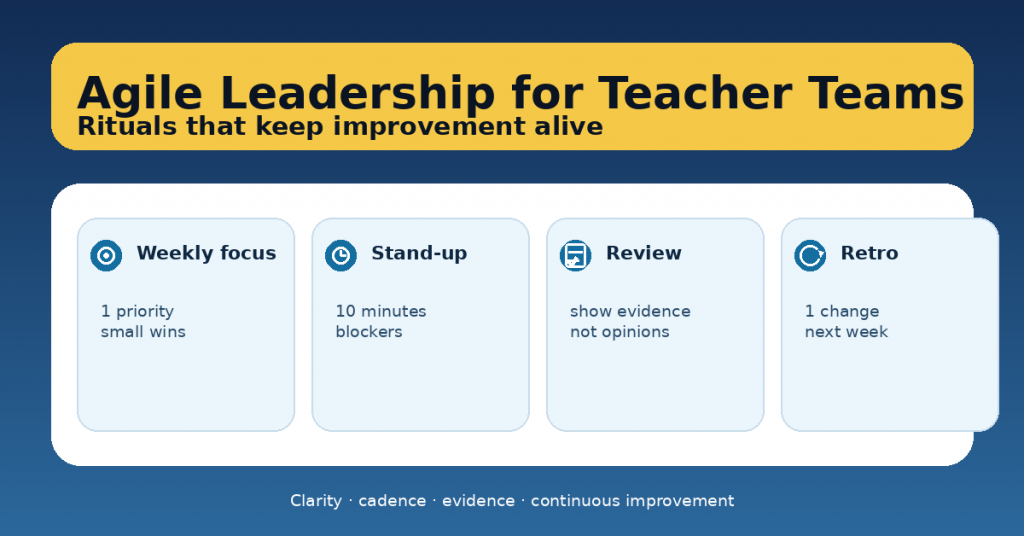
Ritual 1 — Weekly Focus (10 minutes): “One priority, not ten”
Why it works: when everything is a priority, nothing changes.
How to run it
-
Choose one improvement focus for the week (or two weeks).
-
Make it small and observable.
Examples
-
“This week: exit ticket in every class (2 minutes).”
-
“This week: one shared rubric for oral presentations.”
-
“This week: a 5-minute lesson start routine to reduce chaos.”
Output (write it down)
-
Focus: ______
-
Definition of Done: “We’ll know it worked if ______.”
-
Owner: ______ (owner ≠ person who does everything)
Agile leadership move: protect the focus from new “nice ideas” until the cycle ends.
Ritual 2 — Team Stand-up (10 minutes): fast alignment, no discussion spiral
Why it works: it surfaces blockers early and prevents hidden overload.
Cadence: once a week (or twice during heavy project work)
Three questions
-
What did we try since last time?
-
What’s blocked or unclear?
-
What’s our next tiny step?
Rules
-
Stand up (literally) if possible.
-
No problem-solving during the stand-up.
Park issues for later: “Let’s take that offline.”
Output
-
1–3 next actions max
-
Blockers list (with who will unblock)
Ritual 3 — A Visible Backlog + WIP Limit (5 minutes to maintain)
Why it works: teams burn out when work is invisible and unlimited.
Create a simple board (physical or digital):
-
To do
-
Doing
-
Done
Add one key constraint: WIP limit (Work In Progress).
-
Example: “We never have more than 3 items in Doing.”
This forces prioritisation and stops the “start everything, finish nothing” cycle.
Ritual 4 — Definition of Done (DoD): quality clarity before anyone starts
Why it works: vague expectations create rework and conflict.
DoD is a short checklist that answers: What must be true for this to count as finished?
Example: DoD for a shared assessment
-
Aligned to standards/criteria
-
Includes success criteria in student language
-
Has a rubric (max 4 criteria)
-
Includes one example of “Meets”
-
Agreed moderation step (10 minutes)
DoD reduces stress because it replaces guesswork with shared quality.
Ritual 5 — Evidence Review (20 minutes): “Show it, don’t just tell it”
Why it works: teams get stuck in opinion debates. Evidence moves conversations forward.
Once every 2–4 weeks, ask:
-
What evidence do we have that the change helped?
-
What did students produce that shows learning?
-
What did we notice in behaviour/engagement/time-on-task?
Evidence examples
-
10 exit tickets
-
3 student work samples
-
quick data point: completion rate, common errors, time saved
-
a short teacher observation note
Rule: bring something small rather than “general impressions.”
Ritual 6 — Retrospective (20 minutes): one change, next week
Why it works: improvement dies when you don’t learn from your own process.
Use a simple retro format:
-
Keep: What worked that we should repeat?
-
Improve: What slowed us down?
-
Try: One experiment for next cycle.
Golden rule: choose one change only.
Close with a commitment
-
“Next week we will ______. We’ll know it worked because ______.”
Ritual 7 — Decision Log (2 minutes): stop forgetting agreements
Why it works: teams repeat the same conversations when decisions vanish.
Keep a shared note with 3 fields:
-
Decision
-
Owner
-
Review date
That’s it. Culture improves when agreements stay visible.
Ritual 8 — Rotating roles (protect energy, build capacity)
Why it works: leadership becomes sustainable when it’s distributed.
Rotate light roles:
-
Facilitator (time + structure)
-
Scribe (notes + decision log)
-
Evidence keeper (brings artifacts)
-
Blocker remover (checks follow-ups)
Rotation prevents “the usual heroes” from carrying everything.
A ready-to-use cadence (minimal, realistic)
If you want the smallest workable Agile rhythm:
Weekly
-
10’ Weekly Focus
-
10’ Stand-up
Every 2–4 weeks
-
20’ Evidence Review
-
20’ Retro
That’s improvement alive—without extra hours.
What Agile leadership is not
-
Not more meetings.
-
Not complex tools.
-
Not constant change.
It’s small, protected routines that keep teams moving with clarity and care.
